Most beer leagues start the same way: a few friends who play Sunday shinny decide they want real games, real standings and a trophy. The hockey is the easy part. This checklist covers the rest, in the order you'll need it, from booking ice to the first game night.
1. Book the ice first
Everything depends on ice. Rinks book their prime adult slots months ahead, often for the full season.
- Talk to every rink in range, not just the closest. Ask what's open, on which nights, and from when to when.
- Ask for the contract terms: price per hour, deposit, cancellation policy, and whether you must take every week.
- Count your slots. Each slot is one game. With 8 teams playing once a week, you need 4 game slots a week.
- Late slots are often cheaper and easier to get. They're also the ones players complain about. Plan to share them fairly.
2. Ask about insurance and sanctioning
Sort out insurance before you sign anything. Ask your rink what coverage it requires from a league, and ask your provincial or state hockey association, or an insurance broker, what is available for adult recreational hockey. Find out who a policy covers (players, officials, organizers) and what it costs before you set fees.
If you join a sanctioning body, read its rules on rosters, equipment and discipline. It may also set requirements for game sheets and officials.
3. Decide your size and format
- Teams. Six to ten teams is a common start. Fewer, and players see the same opponents every week; more, and you need more ice and more volunteers.
- Players per team. Plan for absences. Many adult leagues carry 13 to 16 skaters and two goalies.
- Season length. Count back from the ice you have, and keep two or three weeks for playoffs.
- Levels. If skill levels vary widely, consider divisions now. One mismatched team ruins a season for two.
- Draft or registered teams. Let groups of friends register as teams, or have individuals register and draft balanced teams. Drafts produce closer games, and more work.
4. Set fees
Add up everything the season costs: ice, insurance, referees, pucks, jerseys if you supply them, trophies, payment processing and a cushion for a cancelled night you still pay for. Divide by the number of players you expect, not the number you hope for. Decide early whether goalies pay, and what happens when someone quits in week four.
5. Write the rules down
A one-page rulebook prevents more fights than any referee. Cover at least:
- Contact: no-contact is the norm in adult rec hockey. Say what happens on a hit.
- Fighting and suspensions: how many games for what.
- Penalty lengths and how they're timed.
- Game format: period lengths, overtime, shootouts, ties.
- Standings: points for a win, a tie and an overtime loss, and the tiebreakers.
- Spares and goalies: who can be called up, and from where.
- Forfeits: when a team is short, and what the score is.
- Playoffs: who qualifies, and the format.
- Conduct, including alcohol at the rink.
6. Find officials
Contact your local referees' association or the rink; many have referees who work adult leagues regularly. Budget for one or two per game, and confirm the fee per game before you set player fees.
7. Register players and collect money
Use a registration form that collects contact details, emergency contacts, a waiver and payment in one go. Chasing e-transfers and paper waivers is where new commissioners burn out. Keep a waitlist; someone always drops out.
8. Build the schedule
With the ice booked and teams set, build the round robin, then balance late games, home and away, and rinks. The free schedule generator does this in your browser with no account.
9. Decide how games are scored and where stats go
Your players will want stats; it's half of why adults sign up for a league instead of shinny. Decide:
- Who scores each game. A volunteer from each team, rotating, works if the tool is simple.
- On what: paper, or an app the scorekeeper can run on their own phone.
- Where results go: a website or app players can check, updated the same night.
10. Give the league a home online
A league website does more work than you'd think: schedules, standings, stats, rules, registration, sponsors and announcements in one place. It's also how new players find you next season.
11. Run game one, then fix what broke
Get to the rink early. Check lineups, the clock and the scorekeeper. After the first week, ask captains what went wrong, and fix it before week two. The first season is the one you learn from.
How HockeySync helps
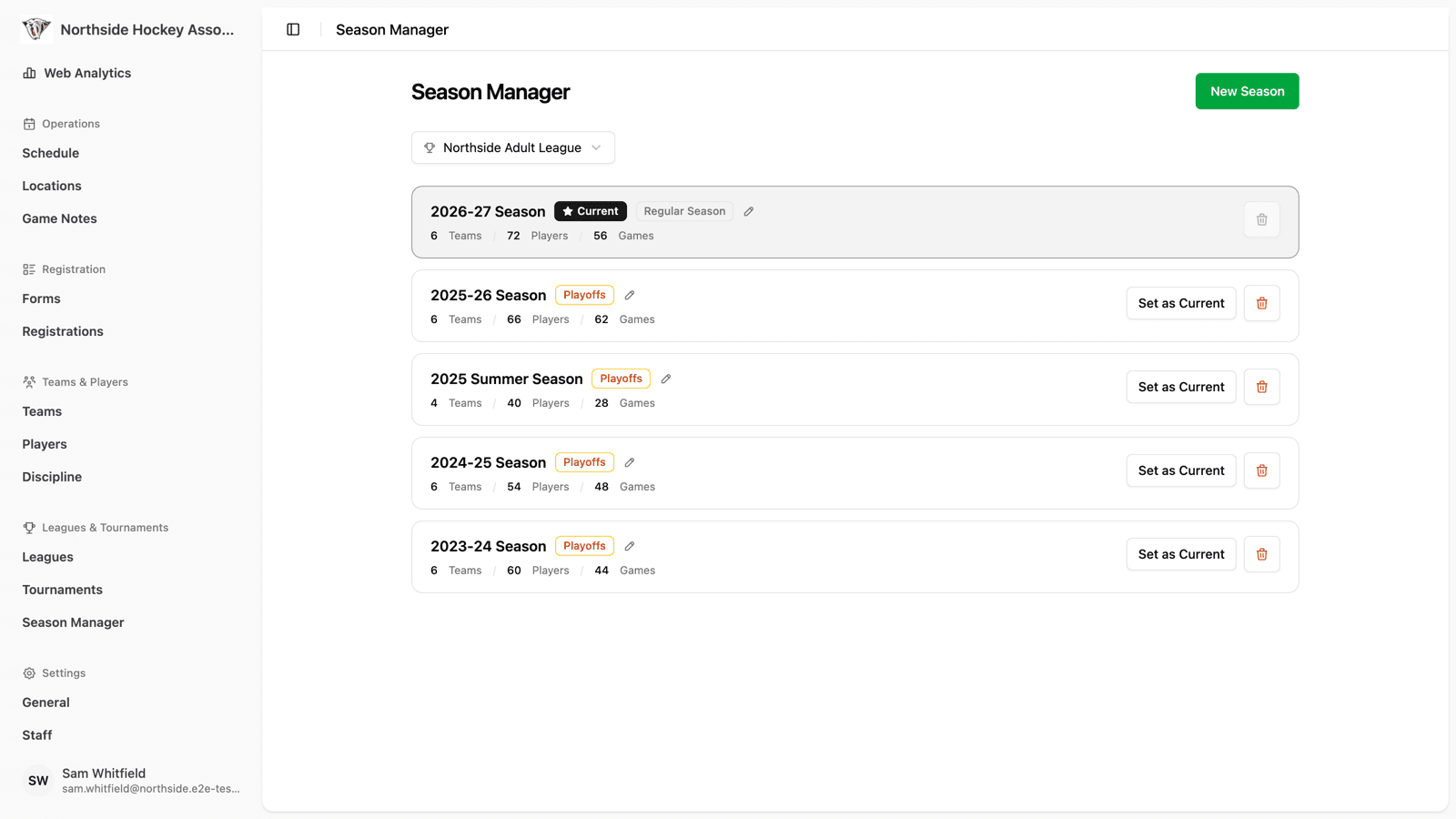
HockeySync covers steps 7 to 10 in one place:
- Registration forms with waivers and online payment. Registrants arrive in a list you add to your rosters.
- The free schedule generator, which drafts a season balanced for late games, home and away, and rinks.
- Live scoring from any phone, with your own penalty lengths, penalty timing and standings points.
- A league website and a free app. Goals show within seconds; standings, player pages and records update when the scorekeeper saves the game.
- On Pro: writing the generated schedule into your season, suspensions, trades and a salary cap for draft leagues, and written game previews and recaps.
The Rookie plan is free for leagues of up to 5 teams, 50 players and 50 games a season. Fifty players is about three full beer-league teams, so most leagues that follow the sizes above will need Pro. Pro has no team or player caps and starts at $599 CAD a year for 100 games.
Questions leagues ask
How many teams do you need to start an adult hockey league?
Four is a workable minimum; six to ten is common. Fewer teams means more rematches; more teams needs more ice and volunteers.
Do adult hockey leagues need insurance?
Ask before you book. Your rink can tell you what coverage it requires from a league, and your provincial or state hockey association or an insurance broker can tell you what is available for adult recreational hockey.
How much should an adult hockey league charge?
Add up ice, insurance, referees, equipment, trophies and payment fees, plus a cushion, and divide by the players you expect to register.
What rules should a beer league have?
At minimum: contact, fighting and suspensions, penalty lengths, game format, standings points and tiebreakers, spares and goalies, forfeits and playoffs.
What software do I need to run a beer league?
Something for registration and payments, a schedule, scoring, and a place to publish stats. HockeySync does all four, free for leagues of up to 5 teams, 50 players and 50 games a season; writing a generated schedule into your season is on Pro.
Related
- How to make a hockey league schedule (step by step)
- How to keep score at a hockey game
- How to choose hockey league management software
- How to manage a hockey team
- How to set up online registration for a hockey league
- Hockey league software for adult and beer leagues
- Live scoring: the hockey scorekeeping app
- What Pro costs